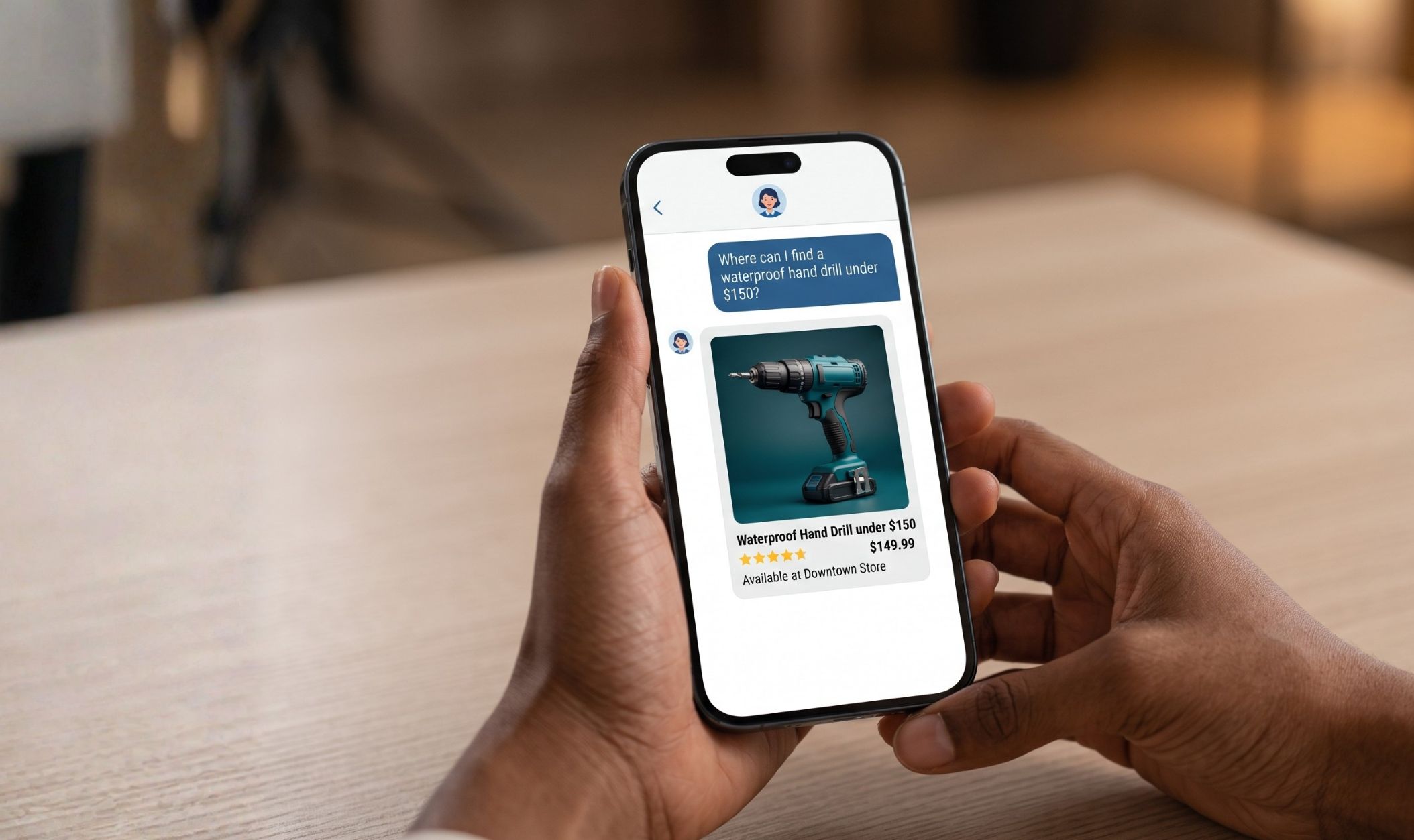
Physical retail shelf space has always been highly competitive, but the evolution of the digital shelf has introduced a new level of competition with AI-driven eCommerce. Prior to this shift, most private label products were developed for traditional online shopping experiences; however, eCommerce is now shifting toward an AI-driven shopping experience.
For example, when a shopper searches for a cordless outdoor drill on Amazon or asks Walmart's Sparky AI assistant for waterproof storage bins, the results are generated by large language models (LLMs). These systems evaluate structured product data, semantic specificity, and the completeness of product attributes, all in relation to the shopper's query. Only products that meet the AI's criteria are presented to the shopper.
Private label programs created before 2023 focused primarily on delivering the physical product. Digital representation, such as product detail pages, attribute layers, and backend catalog data was usually considered after production and often managed by teams far removed from the product development process. This disconnect contributes to gaps in how completely a product is represented on the retailer's site.
This approach made sense when digital search meant humans were entering keywords and browsing product grids. Now, however, AI-driven search systems interpret queries and select which products to display or exclude based on catalog data, changing what it means to be 'found' online.
According to Amazon's Q4 2025 earnings release, more than 300 million shoppers used Amazon's Rufus AI assistant in 2025. On Walmart's Q4 fiscal 2026 earnings call, CEO John Furner and U.S. CEO David Guggina reported that roughly half of Walmart's app users have engaged with Sparky. On Lowe's Q1 2026 earnings call, CEO Marvin Ellison reported that Mylow now handles more than one million customer inquiries per month, and the conversion rate for customers who use Mylow is triple that of customers who do not. In a joint press release, The Home Depot and Google Cloud announced the expansion of the Magic Apron assistant to include real-time local store inventory integration and project-planning capabilities.
These AI systems now serve as large-scale product-ranking engines, not simply as a customer service tool. Each assistant works from a different proprietary mechanism, but the underlying logic is consistent. AI shopping assistants map the language of a shopper's query to the structured data in a retailer's product catalog. When a shopper asks for a "water-resistant outdoor drill under $150 for deck construction," the assistant looks for products whose catalog entries include specific attributes: weather-resistance rating, torque specification, outdoor application, compatible materials, and price tier, expressed in terms that match the query's phrasing. Products with complete and specific attribute data are recommended. Products with fragmented or incomplete data are not.
The practice of preparing product content for AI-driven environments is called Generative Engine Optimization (GEO). Unlike traditional search engine optimization, GEO emphasizes semantic clarity, attribute completeness, and comprehensive use-case coverage in the digital content. Because this is an emerging requirement, most product development processes do not yet capture attribute architecture during the specification phase.
AI assistants have fundamentally changed how products are discovered. They act as intelligent ranking engines that require semantic precision and complete attribute data in addition to the strong visual and descriptive content needed for human shoppers. Traditional catalog structures often fall short because they were built primarily for keyword searches rather than the detailed, interconnected information both AI systems and human buyers need to evaluate intent and surface the right products with confidence. The key opportunity lies in addressing this full attribute architecture during the product specification phase, not as a post-launch fix. Here at Test Rite, we are working directly with retailers to build this dual-purpose data layer from the start, which has become critical for success as AI commerce continues to expand. - Paul Freeman, VP AI & Strategic Intelligence
Today, consumers interact with digital product listings in three primary ways.
The first is the traditional human shopper, who still accounts for most digital traffic. This type of buyer browses product grids, reviews images, reads bullet points, and checks reviews before making a decision. Product detail pages with clear imagery and compelling accurate copy are key for these shoppers.
The second is the AI-assisted human shopper, who uses conversational interfaces to ask specific questions and receives filtered responses from AI assistants. This shopper evaluates only the products recommended by the AI, meaning products that are not surfaced in the AI's response are never considered.
The third is the autonomous AI agent, an emerging but rapidly growing category. Tools like Amazon's "Buy for Me" can make purchase decisions programmatically, with no human involved at the point of selection. These agents evaluate products entirely on structured data, including attribute completeness, price parity, and compatibility with technical specifications.
A private label product designed for all three shopper segments is positioned to maintain visibility as shopper behavior continues to shift. This AI-driven transformation is already in motion, and retailers themselves are accelerating it. Every major retail chain is home improvement, mass, and club channels is deploying or actively rolling out AI-assisted commerce tools as primary growth drivers.
I've seen the difference firsthand: when we re-engineered a core product's catalog data to include explicit compatibility, environmental tolerance, and use-case application data, we saw an immediate shift in visibility. It wasn't just a tweak to the listing; it was an alignment of our product's 'language' with the retailer's AI architecture. In categories where we made this switch, we saw conversion rates jump significantly compared to items that were physically superior but digitally 'mute.' In short, a product that cannot tell the AI exactly why it is the right solution for a specific query will be passed over for a product that can. - Isaac Liao, Senior Director of eCommerce
A product's attribute completeness, semantic specificity, and use-case coverage are most effectively addressed during the product specification phase.
Digital shelf performance issues are often treated as listing problems, addressed by the eCommerce team after launch. The gaps that create those issues, however, almost always originate during the product development phase, long before the product reaches the shelf.
During product development, the specification process typically documents requirements for manufacturing, like dimensions, materials, tolerances, certifications, and packaging. However, the product attribute layer essential to AI-assisted retail, is rarely captured with equivalent thoroughness.
These two sets of information are distinct and originate from different sources. The engineering specification describes the product itself, while the attribute architecture explains how the product should be interpreted by systems designed by others. When attribute architecture is treated as a post-production task rather than integrated into development, the product lands on the digital shelf with a catalog data gap that requires re-engagement with the development team, factory specfications, and retailer content systems to correct.
Test Rite has developed products for leading retailers for half a century. The operational observation is that decisions affecting digital shelf performance are made during the specification stage. Addressing these after the product launch increases cost and complexity.
Test Rite's Content Management service builds and manages the digital asset infrastructure that maintains catalog accuracy and completeness in line with retailer requirements. Connecting content management to the product development phase allows product attributions to be established alongside the physical product.
According to data published by the Private Label Manufacturers Association (PLMA) and Circana, store-brand sales reached a record $271 billion in the United States in 2024, a 3.9 percent increase from the prior year. Retailers across all major channels are forecasting that private-label sales will outpace national-brand sales in their core categories. The investment in private label programs is significant and growing.
AI-assisted commerce is expanding rapidly. Per Amazon's Q4 2025 earnings disclosures, Rufus-assisted shoppers convert at approximately 60 percent higher rates than those who browse without assistance. Per Walmart's Q4 FY26 earnings call, Sparky users generate average order values approximately 35 percent higher than non-users.
A private label product designed for a physical retail shelf or a traditional digital product grid is likely to be excluded from AI-assisted search results without intentional attribute architecture built into the product's specification. Product specifications that include attribute architecture and use-case semantics from the start are the ones AI recommends to the customer. Product attributions and use-case semantics are core specification requirements most effectively addressed during the product development phase rather than after product launch. Product programs that address these requirements during development are the ones that maintain visibility as AI-assisted commerce expands.